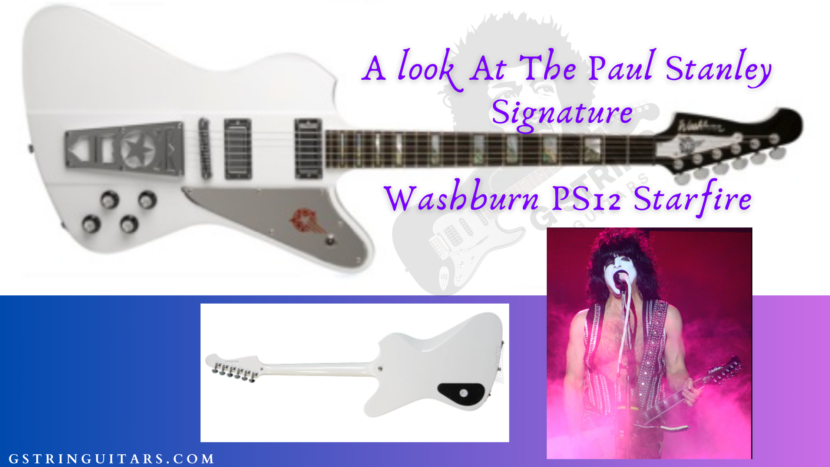
A Bold, Rock-driven Signature Guitar with Mahogany Tone, Mini-Humbuckers, and Unmistakable Paul Stanley Style—Built for Players Who Want Sound and Attitude. Read on…
This Post May Contain Affiliate Links
In compliance with the FTC guidelines, please assume that some of the links on these posts and sites are affiliate links (Amazon or others) from which I may earn a small compensation/commission from sales of certain items at no extra cost to you from qualifying purchases.
Anytime you see a link that looks like “astore.com, paid link, #ad, #CommissionsEarned or Amazon/Amazon.com/ca,”… it can be assumed that it is an affiliate link.
To learn more, follow the link below.
The Washburn PS12 Paul Stanley Signature Guitar
The first thing that stands out about the Paul Stanley Signature Guitar isn’t just the look — it’s the attitude.
As someone who’s spent years playing, researching, and writing about Signature Electric Guitars, I’m always curious whether a model truly reflects the artist behind it or simply carries a name.
In this case, the Washburn PS12 Starfire leans hard into Stanley’s larger-than-life stage presence, blending classic rock tone, bold design, and practical playability.
In this review, I’ll break down what makes this Guitar unique and who it makes sense for as a player.
Instruments Since 1883
Washburn is an American-based manufacturer that started in Chicago (1883), making it one of America’s oldest Guitar brands.

Washburn Guitar Company – Image Courtesy of Wikipedia.org and in the public domain.
Originally known for high-quality acoustic instruments, Washburn built a reputation for craftsmanship and innovation early on.
Over time, the brand expanded to include Mandolins, Banjos, Ukuleles, Acoustic Guitars, and, later Electric models, blending traditional build quality with modern design to serve a wide range of players.
In the 70s and 80s, the company gained prominence through joint-venture collaborations with artists and unique model designs that bridged vintage aesthetics with contemporary performance, performed at the highest level by the most recognized names in the business.
Today, Washburn continues that legacy by producing instruments like the PS12 Starfire, which combine heritage build quality with signature personality for players seeking both style and substance.
Read on
Paul Stanley Signature Guitar – TL;DR
A look at the **Paul Stanley Washburn PS12 Starfire** signature electric guitar — a rock-inspired axe developed with the KISS frontman. It features a solid mahogany body with a carved “raised center,” a mahogany set neck with an ebony fingerboard and split block inlays, and custom chrome mini-humbuckers for versatile tones. The design includes Grover tuners, a custom Paul Stanley aluminum tailpiece and Tune-o-Matic bridge, and standout aesthetics such as a reverse headstock and a mirrored/white pickguard logo. Overall, it delivers great looks and solid playability at a more accessible price point, though some design features (like the reverse headstock and double-action truss rod) may be less traditional.
Paul Stanley and Kiss
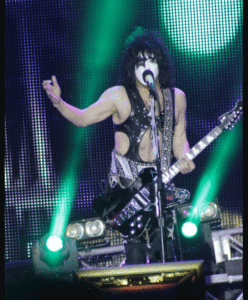
Paul Stanley, with Kiss, playing at Helfest 2013
Guitarist, composer, and performer Paul Stanley began his journey with the instrument at 13 (mostly self-taught) before joining his first group at 15.
Growing up in New York City, Stanley was deeply influenced by the British Invasion and hard rock artists of the late ’60s, absorbing the sounds of bands like The Beatles, The Rolling Stones, and The Who.
Despite being born with microtia, which left him partially deaf in one ear, Stanley pushed forward with a fierce determination to perform and be heard.
Microtia is a birth condition in which one or both external ears are underdeveloped or absent, often leading to conductive hearing loss. Severity varies, and treatment may include hearing support or reconstructive surgery.
His early years were marked by relentless practice, songwriting experimentation, and a growing obsession with stage presence—something that would later become a defining trait of his career.
By his late teens, Stanley wasn’t just playing Guitar; he was shaping an identity as a frontman, blending rhythm, melody, and showmanship in a way that set him apart long before KISS came into the picture.
Early KISS: Guitars, Tone, and Pure Rock Attitude
After meeting Gene Simmons, Ace Frehley, and Peter Criss, they went on to form the powerhouse and visual spectacle known as KISS.
Formed in 1973, early KISS was built on big riffs, loud amps, and an attitude-first tone, with the twin-Guitar approach defining the band and rejecting polished studio perfection in favour of a raw, stage-ready sound.
Paul’s aggressive rhythm playing kept the songs driving and tight, while Ace delivered melodic, blues-based leads that were loose, rebellious, and instantly recognizable.
The tones were mid-forward, gritty, and loud, exactly what worked in packed clubs and arena stages.
Albums like Hotter Than Hell and Dressed to Kill weren’t pristine, but that was the point. The goal wasn’t complexity, perfection or boutique gear—it was about commitment, volume, hard-hitting riffs and visual impact.
Keeping it Real
The Guitars sounded alive, not overproduced.
Cranked amps, simple signal chains, and player feel mattered more than gear obsession.
That raw energy exploded on their Alive! (1975) album release.
This was the band’s breakout record, capturing not only what early KISS really sounded like but also the volume, swagger, and no-safety-net vibe of the band’s persona.
Makeup
The use of the makeup wasn’t random—it was a calculated blend of theatre, identity, and branding, designed to make KISS impossible to ignore and stand out in a crowded 70’s music scene.
Each member created a distinct persona, turning the group into a set of rock-and-roll characters
Struggling to get radio support, the makeup became a visual hook—something unforgettable in clubs and on posters.
It created mystery (they avoided public appearances without makeup) and helped build a loyal fanbase before mainstream success.
Influences Behind the Makeup
Theatrical Rock Influence
Bands like Alice Cooper showed that shock, stagecraft, and visual identity could be just as powerful as the music itself.
KISS took that concept further, turning each member into a larger-than-life character rather than just musicians in a band.
Glam & Performance Art
The glam movement of the early ’70s—especially artists like David Bowie (notably his Ziggy Stardust persona) embraced bold costumes and alter egos.
KISS adopted the idea of transformation but made it heavier, darker, and more comic-book-driven.
Comic Books & Superheroes
Gene Simmons has often cited comic books as a major influence. The band members created personas (The Demon, Starchild, Spaceman, Catman) that felt like superheroes in a rock universe. The makeup made them instantly recognizable and mythic.
Why Paul Stanley Wore the Starchild Makeup
Paul Stanley adopted the “Starchild” persona to amplify his stage presence and express a heightened, almost cosmic version of himself, the charismatic/melodic center of the band. (See image)
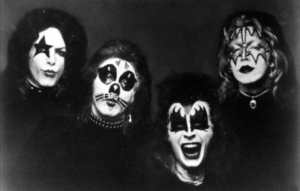
American rock band Kiss w/makeup – showcasing each member’s theatrical version of themselves. Image courtesy of Wikimedia Author- Casablanca Records- work is in the public domain
Empowering
Stanley has explained that the Starchild glamour character represents confidence, mystique, sexuality, romance, and aspirational star power, rather than horror or menace — essentially the bold, fearless version of who he wished he could be offstage.
The black star over his right eye became a symbol of that alter ego: glamorous, magnetic, and emotionally expressive.

In his autobiography Face the Music: A Life Exposed, Stanley discusses how the persona wasn’t just theatrical flair — it was empowering.
The character helped him overcome deep childhood insecurities, including a lack of self-confidence.
He stepped into a role of charisma and command that contrasted sharply with his early struggles growing up in New York.
Onstage, the Starchild persona gave him permission to become larger than life — something that ultimately helped define KISS’s brand and connect with audiences in a dramatic way.
Over 4 Decades
KISS continued to perform at a high level for more than 40 years, with Stanley having co-written many of the group’s most popular songs and drawing on an extensive catalogue.
KISS announced that their End of the Road farewell tour would conclude with a final live show at Madison Square Garden in New York City on December 2, 2023, which was also livestreamed globally for fans.
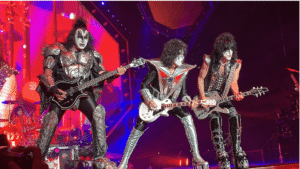
Kiss Live in concert at Krakow 2019
Accolades & Career Highlights (by Year)
1973 – Co-founded KISS, one of rock’s most iconic hard rock bands, becoming lead vocalist, rhythm Guitarist, and co-creative force behind their theatrical style and image.
1978 – Released his self-titled solo album alongside the other KISS members — a rare move that showcased his individual songwriting and performance outside the band.
1978–1989 – Multiple RIAA-certified Gold and Platinum albums/singles with KISS, highlighting sustained commercial success through the band’s peak era.
2006 – Released the solo album Live to Win, earning attention as a solo artist.
2006 – The Hit Parader ranked the Artist 18th on the list of “Top 100 Metal Vocalists of All Time.”
The Hit Parader was a monthly music magazine (1942-2008) that achieved commercial success and popularity when it shifted its focus from general popular music to heavy metal and hard rock in the 1980s.
2010 – Ranked 13th on Gibson.com’s “Top 25 Frontmen” list, recognizing his frontman impact among Guitar and vocal heavyweights.
2014 – Inducted into the Rock and Roll Hall of Fame as a member of KISS, marking one of the highest honours in rock music.
2015 – KISS received the ASCAP Founders Award for exceptional songwriting and influence on popular music over the decades.
2026 – Inducted into the Songwriters Hall of Fame alongside bandmate Gene Simmons, celebrating his lasting contributions to songwriting and rock music.
Paul In Print
Face the Music: A Life Exposed
In his personal, New York Times bestselling memoir, Stanley strips away his stage persona to share his life’s story.
The memoir blends intimate personal revelations, stories behind the band’s rise, candid reflections on relationships with bandmates, and the challenges both on and offstage.
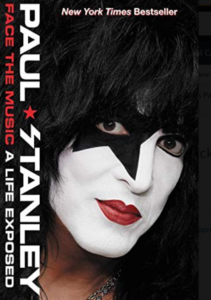
To Get A Copy Of The Book Face the Music: A Life Exposed, -Image courtesy of Amazon.com – Tap On The Image Here
With never-before-seen photos and frank storytelling, Stanley offers a raw, inspiring look at his journey as an artist and a man, not just a rock icon.
Strong Guitar Connection
The book also shows a lifelong connection to the Guitar.
Throughout his journey, the instrument remained central to how he wrote, performed, and led from the stage.
That deep relationship with the instrument eventually translated into Signature Model Guitar designs that would reflect Stanley’s rhythm-driven style of power, melodic clarity, and stage-ready presence.
More than a name on a headstock, his Guitar models represent decades of experience, performance, and identity.
The PS12 Signature
Overview
Officially known as the Washburn PS12 Starfire, this Signature model was built in collaboration with the Artist (2012).
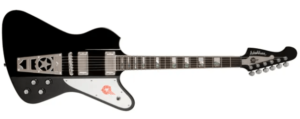
Image courtesy of equipboard.com
Designed to capture the look, feel, and tone, it features a Solid Mahogany body with a carved/raised center, a fast Mahogany neck, and an Ebony fingerboard for smooth playability.
Its Chrome mini-humbucker pickups deliver the bright, cutting tones that make it ideal for classic rock, hard rock, and arena-style performance.
Beyond tone, the instrument stands out visually with Grover tuners, a Tune-o-Matic bridge, a custom aluminum tailpiece, and the iconic Starfire logo.
(Read On)
Body Design
Mahogany Body w/Raised Center
A Solid Mahogany body delivers warm tones and ample sustain, features a carved Stanley-approved “Raised Center“,
“The raised centre helps focus the wood’s vibration and contributes to the instrument’s sonic character.”
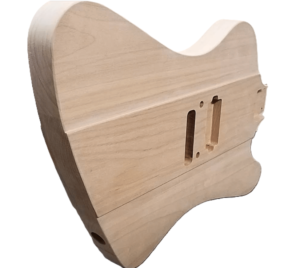
A look at a raised centre design body- Image courtesy of kneguitars.c0m
Body Shape
Its body shape is an unmistakable reverse-silhouette, crafted for comfort and elegance, and accented with numerous distinctive features. It is available in black or white. (See Image)
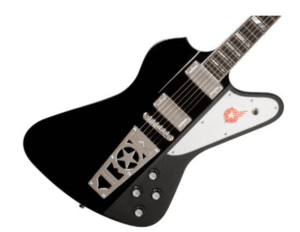
Reverse body style in black – image courtesy of Amazon.com
Neck
The fast Mahogany Set-neck features a 14″ fingerboard radius and a 24-3/4″ scale length, 22 Jumbo frets with bound ebony fingerboard and pearl/abalone split block inlays serving as fret markers (See image)
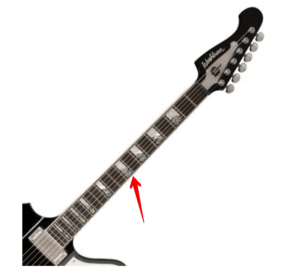
Mahogany Set Neck w/pearl/abalone split block inlays – Image courtesy Amazon.com
Set Neck
Like the Bolt on construction, the neck and body are milled and manufactured separately, but with a Set Neck instead of screws to secure the junction, super-strong glue is used.
Truss Rod
The Neck stability is provided by a double-action truss rod.
A double-action truss rod is a device inserted inside the neck capable of recreating a concave or convex curvature on the fingerboard, independent of string pull.
Identical to that of a single-action truss rod.
Reverse Headstock
The headstock is equipped with 18:1 Grover diecast tuners for precise tuning, a graphite nut, and a shaped mirror or white truss rod cover. (See image)
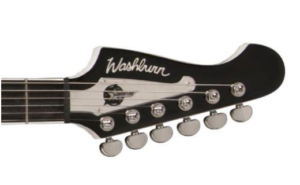
Grover Tuners & White Truss Rod Cover – Image courtesy of wwbw.com
The mirrored or white pickguard ties in with the reverse headstock. Both contain a silkscreened variation of the Paul Stanley Starfire logo (See image)
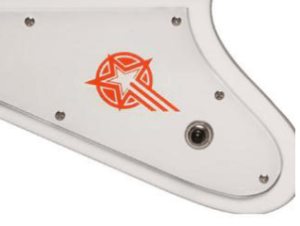
Image courtesy of wwbw.com
Tune-o-Matic Bridge
Machined from Solid Aluminum
This tailpiece works alongside the instrument’s graphite nut, adjustable bridge, and tuners to ensure your strings stay in tune while looking great.
This custom stop tailpiece is machined from solid aluminum to adjust string intonation. (See Image)
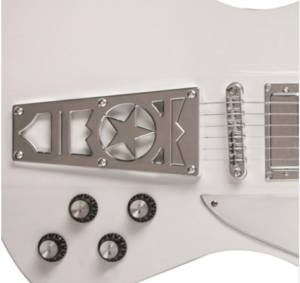
Tune-o-Matic bridge; custom Paul Stanley tailpiece machined from solid aluminum -image courtesy of wwbw.com
Powerstation
Mini Humbuckers
Instead of the Seymour-Duncan SM-3 found on the previous Starfire, Washburn opted for 2 chrome mini-humbuckers.
The high-output pickups produce a tone all their own that is versatile, giving you a wide selection of tones to choose from. (See Image)
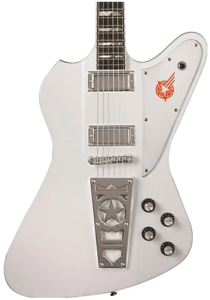
High output 2 chrome mini-humbucker pickup -Image courtesy of wwbw.com
What’s the Difference in Tone
Mini humbuckers themselves sit tonally between traditional full‑size humbuckers and single‑coil pickups.
Because they “sense” a shorter section of string vibration, they tend to produce clearer, brighter tones with strong midrange presence and good note definition, while still reducing hum and noise like a humbucker.
That makes them a good choice for Guitars that want both clarity and warmth without the thicker, heavier tone of full‑size humbuckers. (allforturntables.com)
Controls
Lots of Different Tone Options
This Guitar sports 2 volume and 2 tone top hat control knobs with a 3-way pickup selector.
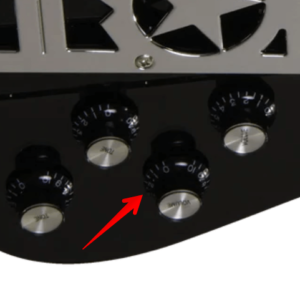
Image courtesy of Sweetwater.com
According to Washburn, “The use of the volume and tone controls will reward the player with a wide palette of biting or creamy sustaining tones.”
Value & Style
Budget Friendly
Designed to be balanced, easy to play, and with its own distinctive look and sound, this Guitar was built to be within reach of most budget-conscious musicians, reflecting the true spirit of the Washburn business culture by delivering value and style.
FAQ’s
What makes the PS12 different from a Standard Electric Guitar?
- The Starfire features specific hardware, giving it a distinct tone, feel, and visual identity compared to standard electrics.
Is the Signature Guitar good for beginners?
- Yes. While it’s designed with professional features, the Washburn PS12 Starfire is approachable for beginners thanks to its comfortable neck profile, stable tuning hardware, and versatile pickups, making it suitable for players at multiple skill levels.
What style of music is the Paul Stanley Signature Guitar best suited for?
- It excels at classic rock, hard rock, and arena-style rhythm and lead playing, but its mini-humbuckers also provide enough clarity for blues and lighter rock styles.
Video
Final Thoughts
Stage-Ready
With this instrument, you get a lot of Guitar for your money, and the value is in the details. It’s great-looking, easy to play, and stage-ready.
I always loved the look, play, and feel of the Gibson Firebird, and this Guitar reminds me of Washburn’s version. Also, some features have been simplified, but its look and feel are identical to the custom shop models, except that it is within reach of most budgets.
Truss Rod Debate
For decades, Guitars have used single-action truss rods with great success. I have played for over 30 years and have never felt the need to change. But that might not be the case when it comes to Paul Stanley’s reality.
Some players say that if you are looking for a more vintage tone, stay with a single truss rod, but if you are playing heavier styles of music, go with a double.
I suspect either approach is fine, but 99% of the time, a single truss rod is all that is needed.
Reverse Headstock “Need to Know”
Beyond the look, I think the “reverse“ headstock changes the sound of the instrument.
The longer length of the bass strings gives you more clarity and snap, and the shorter length of the treble strings provides a tighter playing feel, easier for bending and vibrato, as well as adjusting the tuning heads at the bottom of the headstock may take some getting used to.
Should You Add This Guitar To Your Collection?
It depends on your budget and player type, but if you are a Guitarist who prioritizes rock rhythm and lead tones, vintage‑inspired aesthetics, and a mid-range-priced Signature Model with character, then this is for you.
This instrument may feel a little niche, but overall, for rock Guitar lovers or collectors, it’s a standout choice.
Want More Paul Stanley?
To See More Paul Stanley & Kiss, Tap On the Image Here
Did You Like This Article?
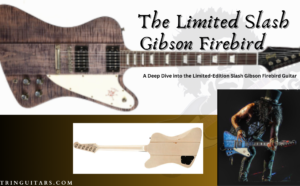
Check out my review of the Slash Signature Gibson Firebird.
What Do You Want To See
Leave me your comments in the section below, if you would like me to review a favourite Guitar/Topic or Artist.
As always, stay the course, keep playing and see you in 30 days.
I’m Dino Paniccia — a Guitarist, Gear enthusiast, and the founder of GStringuitars.com. I’ve spent years playing, teaching, recording, researching, and writing about Electric Guitars, with a particular focus on Signature Models and what actually makes them special for real players. My goal is to break down tone, feel, and design in a practical, player-first way so Guitarists can make confident, informed gear decisions.
Summarize This Content with AI
Attributions
Blog Banner images
-
Paul Stanley image courtesy of Llann Wé².@wikimedia and creativecommons.org/ share alike 3.0
-
Guitar images in blog banner courtesy of guitarsite.com and sweetwater.com
-
Paul Stanley, Kiss, Helfest 2013 – Image courtesy of Wikimedia – Llann Wé² – is licensed under the Creative Commons Attribution-Share Alike 3.0 Unported
-
Image of makeup- courtesy of Wikimedia, Author Willtron and is licensed under the Creative Commons Attribution-Share Alike 3.0 Unported license.
-
Kiss Live in concert at Krakow 2019 – Image courtesy of Wikimedia – Author Nashville69 – is licensed under the Creative Commons Attribution-Share Alike 4.0 International
-
Final thoughts image created by Gstringuitars on Bing.com
-
Paul Stanley CTA Courtesy of Amazon.com

To Get Back to Homepage – Tap Image
Washburn PS12 Starfire Solidbody Electric Guitar
$632.93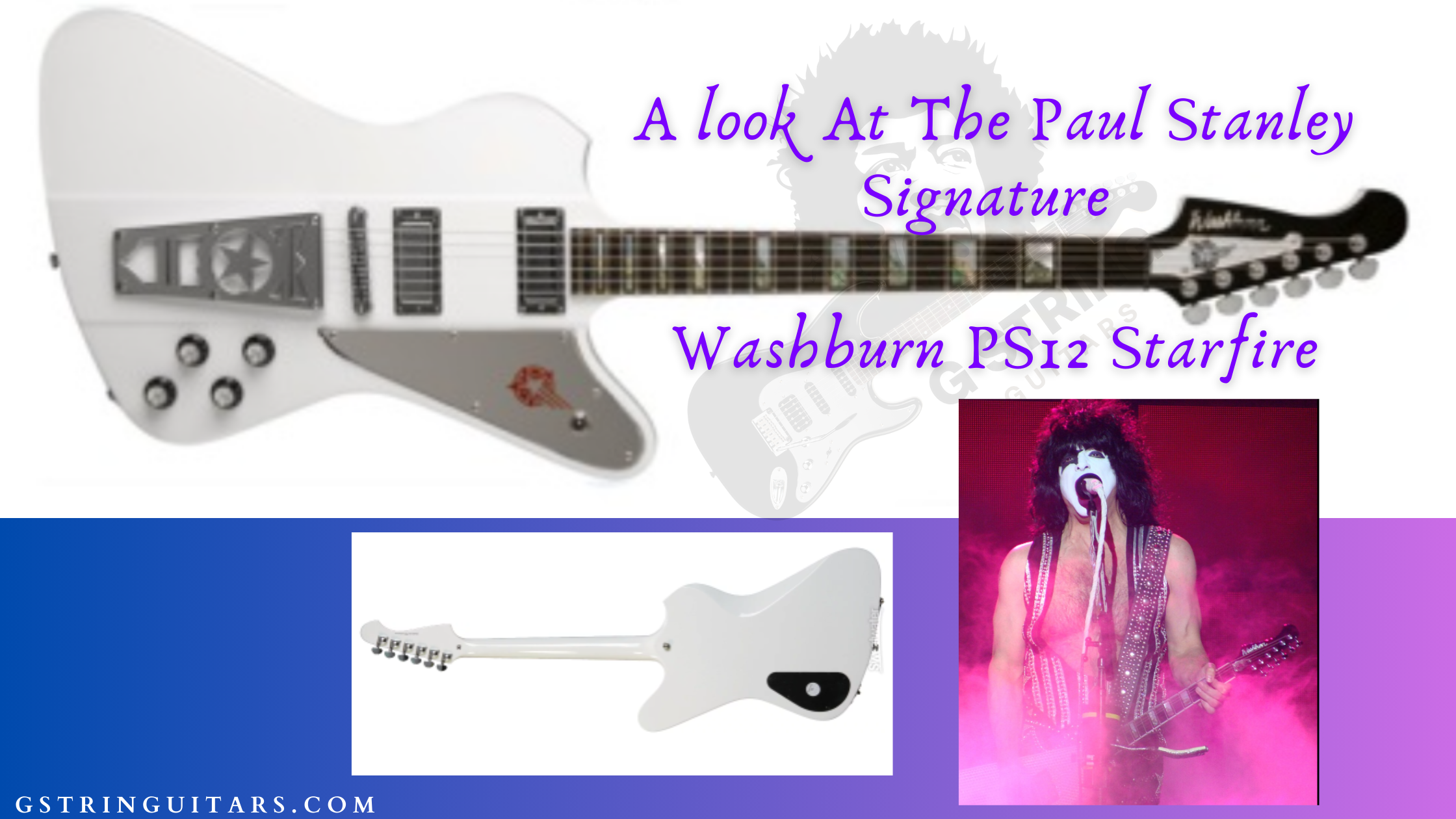
Pros
- Chrome mini-humbucker pickups
- Pearl/abalone split block inlays.
- Scale-length of 24-3/4"
- Graphite nut, Grover tuners
- Neck scale-length of 24-3/4"
Cons
- Reverse headstock for turning heads
- Double-action truss rod

Starting A Journey At 7 Years Of Age, The Love For The Guitar Only Became Stronger Going Into My Teens. This Leading To An Exciting Time Of Teaching, Performing, And Recording. Join Me Now As We Can Bring The Love Of This Instrument To Other Musicians Globally.