Baritone Electric Guitars deliver deeper tunings, tighter low-end response, and a bold tonal range standard Guitars can’t reach.
With longer scale lengths and heavier strings, they’re ideal for modern metal, ambient textures, and rhythm-driven playing.
This guide covers what they are, how they sound, and who they’re best suited for. 🎸
Read On…
This Post May Contain Affiliate Links
In compliance with the FTC guidelines, please assume that some of the links on these posts and sites are affiliate links (Amazon or others) from which I may earn a small compensation/commission from sales of certain items at no extra cost to you from qualifying purchases.
Anytime you see a link that looks like “astore.com, paid link, #ad, #CommissionsEarned or Amazon/Amazon.com/ca,”… it can be assumed that it is an affiliate link.
To learn more, follow the link below.
Baritone Electric Guitar
The Complete Guide for Players Who Want Lower, Heavier Tone
A Baritone Guitar looks similar to a regular electric —but the moment you play it, you’ll hear and feel the difference.
They are designed to reach lower notes than a standard Guitar, while maintaining string tension and playability, without sounding muddy or loose.
If you’ve ever wondered why some Guitars sound darker, tighter, and more powerful, or questioned whether a Baritone Electric Guitar is hard to play, this guide will walk you through the basics in plain language—what it is, what makes it different than a regular electric, and whether it’s right for you.
Read on…
What Is a Baritone Guitar?
Specialized Instrument
Physically, Electric Baritone Guitars often have a slightly larger body and a longer neck, and often resemble an oversized Strat/Superstrat/Les Paul- or Tele-style models.
The difference is subtle at first glance but noticeable when compared side by side with a standard electric. (See Image)
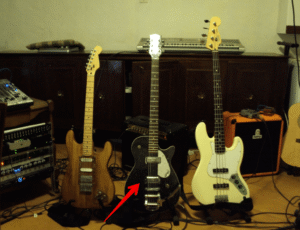
Size comparison between a standard (25,5 inches) homemade Stratocaster-shaped Electric Guitar(left), a Gretsch G5265 Jet Baritone (29 3/4 inches) (middle) and a Fender Jazz Bass (34 inches) (right).
🎸 Standard Guitar vs Baritone vs Bass
| Feature | Standard Electric Guitar | Baritone Guitar | Bass Guitar |
|---|---|---|---|
| Typical Role | Melody, chords, lead & rhythm | Low-end rhythm & texture | Foundation & groove |
| Number of Strings | 6 | 6–7 | 4–5 (sometimes 6) |
| Scale Length | 24.75″ – 25.5″ | 26.5″ – 30″+ | 30″ – 34″+ |
| Common Tuning | E Standard | B or C Standard | E Standard (1 octave lower) |
| Pitch Range | Mid to high | Low to mid | Very low |
| String Gauge | .009 – .046 | .013 – .062 | .045 – .105+ |
| Best Used For | Lead playing, solos, and versatility | Heavy riffs, ambient tones, down-tuning | Groove, rhythm foundation |
Both Electric & Acoustic
You can find Baritone Guitars in electric or acoustic varieties, made by most respected brands.
Each caters to different styles/players and, like standard models, are typically 6-string but can come in 7-string designs.
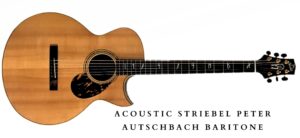
Peter-Autschbach-Signature Acoustic 6-string Baritone Guitar
Brands That Offer Baritone Guitars
| Brand | Best For | Tone Character | Player Type |
|---|---|---|---|
| PRS | Versatile styles | Balanced, clear, modern | Players who want one Baritone for Baritoneres |
| Fender / Squier | Surf, country, alt-rock | Twangy, punchy, vintage-inspired | Players chasing classic baritone vibes |
| Ibanez | Metal, prog, modern rock | Tight, aggressive, focused | Technical & modern riff players |
| Schecter | Heavy rock & metal | Thick, powerful, dark | Down-tuned rhythm players |
| Danelectro | Surf, spaghetti western, rockabilly | Jangly, retro, resonant | Vintage tone seekers |
| Gibson / Epiphone | Rock, blues, crossover styles | Warm, full-bodied | Traditional players exploring lower tunings |
| ESP / LTD | Extreme metal | Precise, aggressive, high-output | Heavy & extended-range players |
TL;DR – The Baritone Electric Guitar
The Baritone Electric Guitar sits between a standard guitar and a bass, offering a longer scale length, lower tuning range, and tighter low-end response. It’s ideal for players who want heavier riffs, clearer low notes, and modern tones without switching to a bass. Popular in metal, contemporary rock, ambient, and cinematic styles, baritone guitars excel at rhythm playing, dropped tunings, and atmospheric textures—making them a powerful tool for guitarists chasing depth, clarity, and punch.
What is a Baritone Guitar used for?
The purpose of a Baritone is to extend a Guitar’s range into lower frequencies while keeping the familiar feel and playability of a Standard Electric.
Lower End of The Sound Spectrum
This unique instrument bridges the gap or “Fills in” the lower end of the sound spectrum in recordings and performances, sitting between a standard Guitar and Bass in both pitch and function.
This ability to reach lower notes than a standard model while staying above a Bass makes them ideal for thick rhythm parts, layered arrangements, and filling sonic space in a mix, while maintaining clarity in both recordings and live performances.
History & Genre Evolution
Historically
The Baritone traces its roots to early stringed instruments such as the Viola da Gamba and Gibson’s Mandocellos, all designed to explore deeper tonal ranges.
1950 Evolutions
The official Baritone first appeared in the late 1950s, with Danelectro releasing the first mass-produced 6-string in 1956, quickly gaining popularity in surf, spaghetti westerns, and country music. (See Image)
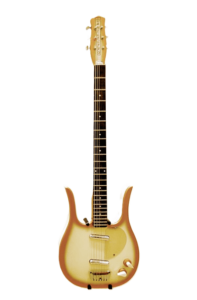
A 1958 Baritone Danelectro 4623 Longhorn six-string
Surf Music
Hearing this instrument was most famously done through Duane Eddy’s signature twang, where he used Baritones for punchy, reverb-soaked riffs.
Brian Wilson (Beach Boys) employed the sound and instruments for thick, bass-heavy lines in his classical Surf music.
Western Soundtracks
Iconic Western themes like The Good, the Bad and the Ugly showcase the Baritone’s atmospheric voice, which helped shape the sound of the Wild West.
Country
For country music in the 1950s and ’60s, Baritones became popular for doubling acoustic Bass lines in the studio.
Nashville-based producers famously used these Guitars to double lines over acoustic stand-up Basses, which were notoriously difficult to mic for recording purposes.
This punchy technique —a percussive, high-frequency “Click” to the low end of the recording (accented on 2 & 4) as “tic tac” (doubling of the Bass line with variations)—helped producers achieve a clearer low end and is still used in specific country subgenres today.
Country Baritone Players
Players in country music include Glen Campbell, Merle Haggard, Dwight Yoakam, Brad Paisley and Chris Hillman of the Desert Rose Band.
1978 Veillette-Citron Shark
Many believe that the first true purpose-built Electric Baritone arrived in 1978 when Joe Veillette and Harvey Citron built the Veillette-Citron Shark for John Sebastian. (See image)
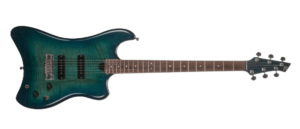
Veillette-Citron Shark Baritone Guitar, with 27-inch scale length- Image courtesy of Equipboard.com
80’s Metal Resurgence
From the 1980s onward, Baritone Guitars found a strong foothold in hard rock/nu-metal, post-punk, thrash, and progressive styles, cementing their place through players and bands seeking darker, heavier tones.
Making them ideal for handling percussive low-end down-tuned heavy riffing and precise rhythm work with tight articulation, rather than fast, high-register lead lines.
Modern Rock Guitarist using the Baritone
Eddie Van Halen
- Notably used a custom-made Ernie Ball Music Man double-neck Baritone during the “For Unlawful Carnal Knowledge” era (1991-1992), featuring it in songs “Spanked and Runaround.”
James Hetfield (Metallica)
- Used a Custom 27″ scale length ESP/LTD Baritone (Mid 2000’s) called the Grynch Viper, with a black finish and green flames (See Image)
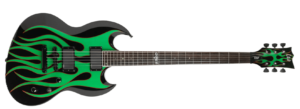
Image courtesy of stangguitars.com
- As well as more recently the “ESP LTD Snakebyte“, which is a special edition version of his Signature Snakebyte with the same scale as the viper (27″) but with a see-through Purple Sunburst finish. (See image )
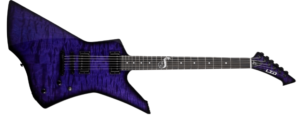
Image courtesy of ZZ Sounds.com
Brian “Head” Welch (Korn/Love and Death)
- Used a 6-string Ibanez Baritone model, RGD Shape (2005), as opposed to the 7-strings commonly used in Korn, as well as an ESP custom Baritone model (2017-2024), recently returning to Ibanez in 2025 as there Brand representative.
Why Metal Players use Baritone Guitars
| Extended Range | Supports much lower tunings for heavier, thicker riffs. |
| String Tension & Clarity | Longer scale length keeps low notes tight and defined. |
| Sonic Texture | Adds a deep, resonant character standard guitars can’t match. |
Present & Future Beyond Metal
While the Baritone Guitar is commonly paired with metal, its beauty extends far beyond just one genre.
What was once a niche instrument has evolved into a versatile creative tool for players seeking depth, clarity, and extended range in all styles
Other influential Guitarists who have embraced the Baritone include…
John Petrucci (Dream Theatre)
- He primarily uses BFR (Ball Family Reserve) models and custom Majesty Baritone Guitars. These instruments, featured on tracks like “Panic Attack” and “Paralyzed,” allow him to maintain high-gain, precise, and aggressive tones live and in the studio.
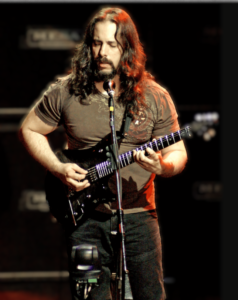
Pat Metheny – Jazz Solo Artist
- Explores experimental tones with his custom-made acoustic, crafted by Canadian luthier Linda Manzer, who specializes in nylon string Baritones. These Guitars are designed with a specific scale length to handle his unique tuning, which often involves tuning the middle two strings up an octave.
Joe Bonamassa – Blues-Rock
- Delivers grit and punch on modern blues tracks like “The Ballad of John Henry,” with his 2009 Custom Ernie Ball Music Man double-neck featuring a Baritone 27.75-inch scale length on the upper neck and a standard scale (25.5″) on the bottom. (See image)
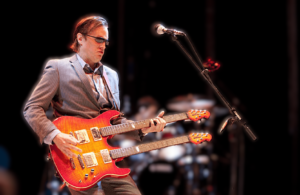
Similar Play
The important thing about playing a Baritone is that it still feels familiar to play, the string intervals remain the same, and you can use familiar chord shapes/scale patterns, without forcing you to relearn anything.
Tuning of a Baritone
Easy to Adopt
Tuning of these instruments is straightforward once you’re familiar with the lower pitch range.
Using a chromatic tuner with Baritone tuning options will ensure accuracy.
A regular Guitar’s standard tuning (from lowest–pitched string to highest) is E–A–D–G–B–E.
While Standard Guitars struggle below Drop C, Baritones stay tight at Drop C, B, or A
Common Baritone Tunings
While no standard tuning has been established for Baritone Guitars, popular tunings for the instrument are:
C Standard
- Major 3rd below E standard
- Tuning is (C–F–A♯/B♭–D♯/E♭–G–C)
B Standard
- Perfect 4th, down from E standard
- Tuning is (B–E–A–D–F♯–B)
A standard
- A perfect fifth below E standard
- Tuning is (A–D–G–C–E–A)
Alternate Tunings
Just like with other Guitars, you can experiment with various alternate tunings, including drop A/B and open tunings like open G.
- Drop A (A1–E2–A2–D3–F♯3–B3): A dropped tuning used for metal, where the low B is dropped a full step to A.
- Drop B (B1–F♯2–B2–E3–G♯3–C♯3): A dropped tuning derived from B standard, common in rock and metal for a heavier, “chunky” sound.
Tuning Tip
Most Baritones can handle these common tunings, and if you’re unsure, B standard is a good starting point.
Adjusting for Playability
If the strings feel too tight or too loose, you might need to adjust your tuning slightly.
Remember, the goal is a comfortable tension that still delivers a deep Baritone sound
Because Baritone strings are thicker and under higher tension, tune them down gradually and give each string a moment to settle.
E Standard Not Recommended for Baritones
Never try to tune a Baritone Guitar to E standard using Baritone strings.
Those thick, high-tension strings could put excessive strain on the Guitar neck if tuned to E Standard, and Manufacturers warn that these Guitars with Baritone strings could potentially damage the instrument.
Always keep the Guitar tuned to Baritone ranges unless you swap out for lighter strings and do a proper setup.
Video, Tunings & Related Theory
String Gauge Matters
Your tuning of choice will determine what Guitar strings you should buy.
First, ensure you’re using heavier-gauge strings designed for Baritones.
A poorly matched string set will result in unbalanced string-to-string tension and less-than-ideal playability.
Standard Guitar Strings Not Recommended for Baritones.
Like the cautioning against E standard tuning, Regular Guitar strings are also not recommended for Baritone Guitars due to their longer scale length and typically lower tuning.
Recommended String Gauges for Baritone Guitars
For optimal performance, Baritones typically use strings in the gauge ranges (.012–.060), (.013–.062), and (.014–.068).
If unsure, refer to the manufacturer’s specifications or consult your local Guitar Tech.
🎸Baritone Guitar String Guide
| Aspect | Recommendation | Notes |
|---|---|---|
| String Gauge | (.012–.060), (.013–.062), and (.014–.068) | Optimal tension and clarity for low tunings |
| Scale Length | 26.5″ – 30.5″ | Maintains tight strings for deep tones |
| Tuning | B Standard (B–E–A–D–F♯–B) or lower | Same intervals as standard Guitar, deeper voice |
| Genres | Metal, Jazz, Country, Rock | Thick strings support low riffs & clear melodies |
| Tips | Adjust technique for longer neck & heavier strings | Chords, bends & scales feel different but rewarding |
Why Baritone Guitars are Rarely Used for Lead Playing
The deeper tuning makes individual notes sound heavier and darker, which can mask fast runs or intricate solos that would stand out clearly on a Standard Electric Guitar.

The longer neck also spreads frets farther apart, making quick finger movements and stretches slightly more challenging for fast, technical lead playing.
Additionally, the thicker strings required for low tunings add extra tension, making bending notes or applying vibrato more difficult.
Tip:
Lead shredders who stick to fast, melodic solos might prefer a 7-String Guitar instead.
Recommended Pickups for Baritones
While the extended scale defines the core sound, pickup choice greatly shapes the final tone, allowing a sonic range from bright and open to dark and compressed, making it far more versatile than its low-end focus suggests.
When choosing pickups, the key is clarity in low tunings.
Pickups voiced specifically for extended-range or down-tuned Guitars help retain high-end definition while reducing muddiness.
From there, the best choice depends on your playing style.
Common Pickups and Tonal Profiles
Danelectro Models deliver the familiar jangle and sparkle heard in early country, surf, and spaghetti western music with there Single-coil option lipstick tube pickups.
A lipstick Pickup is a form of single-coil magnetic Guitar pickup, having its electronics totally encased in a chrome-plated metal tube. (See Image)
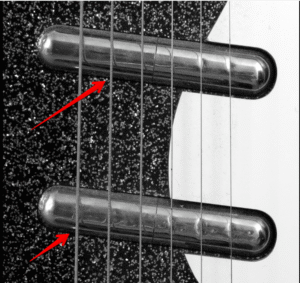
Chrome “lipstick-tube” pickups on a Danelectro Electric Guitar
Tele-style Baritones work well with vintage-voiced pickups for tic-tac Bass tones, while higher-output single coils or rail-style pickups suit heavier styles.
Strat-style Baritones benefit from vintage single coils for’ 50s–’60s sounds, or hotter designs for tighter low-end and modern clarity.
SuperStrat Baritones, equipped with Humbucker pickups and available in both passive and active configurations, are ideal for modern metal, progressive, and down-tuned styles, providing tighter low-end response.
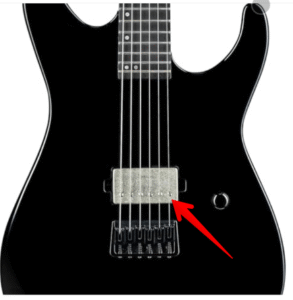
An ESP LTD M-201 Baritone HT Guitar, Black with Single Humbucker. Image courtesy of Amazon.
Tip:
Amp/Cables
Along with the pickup options, choose an amp that reproduces low frequencies clearly, as well as high-quality cables, which help preserve the Guitar’s tone, preventing it from becoming muddy
Benefits of Baritone Guitars
More than just a lower-sounding Electric Guitar, Baritones offer unique advantages that make them a powerful addition to any Guitarist’s lineup.
Superior Tuning Stability
- Thanks to their longer scale length and heavier strings, Baritones stay stable in lower tunings. This consistency is especially valuable in studio sessions and live performances, where a tight, reliable pitch is essential.
Creative Freedom
- The deeper voice and alternate tuning of a Baritone inspire new chord voicings, riff ideas, and songwriting approaches—offering a fresh perspective even for experienced players used to standard-scale Guitars.
Comfortable Playability
- With increased string spacing and a longer fretboard, Baritones can be comfortable for players who prefer extra room under the fingers, particularly during rhythm-heavy playing.
Better Band Integration
- In a full mix, Baritone Guitars fill the low-mid range without clashing with Bass Guitars or higher-register instruments, helping create a fuller, more balanced band sound.
What Does a Baritone Guitar Sound Like?
In short: deep, warm, and resonant.

A Baritone delivers a thicker, fuller tone than a Standard Electric, with rich low-end depth and excellent sustain thanks to its longer scale length.
Chords sound lush and expansive—almost piano-like—especially when paired with reverb or ambient effects.
On the low strings, Baritones produce a thick, twangy voice.
Higher up the neck (or with a capo), they can cover standard-Guitar territory, but with a darker, heavier tonal character.
Video
More Frequently Asked Questions
Is it Worth Getting a Baritone Guitar?
- Yes, it’s worth it if you’re looking to explore a broader range of tones and sounds. It’s especially beneficial for music that benefits from deeper, resonant tones, such as nu metal, jazz, and country.
Are 7-string Guitars Baritones?
- No, while some 7-string Guitars offer a lower range similar to Baritones, they are distinct instruments on their own right.
What Sets Them Apart?
- Baritones use a specific tuning and scale length that sets them apart from standard 7-string models.
Is a Baritone Guitar Just a Bass?
No, Baritones are not Basses.
The significant differences include:
- Number of strings: Four or five on a Bass vs. six or seven on a Baritone.
- Their most popular tuning, compared to a six-string Guitar, is an octave down for Basses versus a perfect fourth for Baritones.
- Scale lengths: Bass Guitars generally have a longer scale length, though there is some overlap between short-scale Basses and the longest-scale Baritones.
Bass Player Friendly
It is well-suited for Bassists looking to explore higher registers, but it will not replace the low end a Bass Guitar provides.
Are Baritone Guitars Suitable for Beginners?
- Yes, especially those interested in genres that make use of their deep tones, such as nu metal or jazz. However, the transition may require some adjustment due to the different tuning and feel.
Who Should Not Start with a Baritone
- A Baritone Guitar is usually not ideal as a first or only Guitar.
- If you’re still learning basic chord shapes, scales, or building finger strength, the heavier strings and longer neck can feel discouraging.
- Players who rely heavily on wide bends, fast lead runs, or traditional blues phrasing may also find a Baritone less comfortable at first. In those cases, a Standard-Scale Guitar will provide a more forgiving, familiar experience.
Is a Baritone Guitar Harder to Play?
- No Baritones are not harder, just different, especially if you’re completely new to them. They can take some time to get used to.
Can you Play Normal Songs on a Baritone Guitar?
- Yes, but they’ll sound lower in pitch – typically a fourth down. You can still strum the same chord shapes and melodies, but expect everything to sound deeper. Transposing or using a capo can help if you want it back in standard tuning.
Final Thoughts
Artist Looking For More
My view is that this instrument rewards players who lean into its feel, range, and purpose. One of the biggest strengths is how it pushes you out of familiar territory.
Understanding what a Baritone is unlocks a wider tonal palette and new creative possibilities, and its uses are limited only by creativity.
Great for Recordings
For many home studio players, the instrument can be a powerful writing/recording tool, adding sonic fullness and becoming a unique and inspiring part of your setup.
Even if you don’t end up using it on every track, spending time with this Guitar can refresh your creativity and help you break out of repetitive playing habits, making you “think” differently.
Should You Add One to Your Collection
I believe adding a Baritone Guitar makes sense if you already have a solid foundation on a Standard Guitar and want to expand your tonal range for the reasons above.
Did you like this Article?
Check out my post on everything you want to know bout the Guitar Scale Length Explained
Also…
Leave your comments in the section below, and if you want me to review a favourite Guitar or Artist Signature Instrument.
As always, stay the course and keep playing.
See you in a couple of weeks for my next post.
About the Author
I’m Dino Paniccia — a Guitarist, Gear enthusiast, and the founder of GStringuitars.com. I’ve spent years playing, researching, and writing about Electric Guitars, with a particular focus on Signature models and what actually makes them special for real players. My goal is to break down tone, feel, and design in a practical, player-first way so Guitarists can make confident, informed gear decisions.
Summarize This Content With AI
Attributions
The side-by-side Strat-styled Electric guitar, the Baritone Guitar and the Bass guitar, courtesy of Wikimedia, Author Danny Ayers from Mozzanella, Italy. And is licensed under the Creative Commons Attribution 2.0 Generic license.
Image of the Peter-Autschbach-Signature Acoustic Baritone Guitar – Image courtesy of Wikimedia – Author Hufpat – The Copyright holder of this work allows anyone to use it for any purpose, including unrestricted redistribution, commercial use, and modification.
A 1958 Baritone Danelectro 4623 Longhorn six-string Guitar – Image courtesy of Wikimedia – Author Andrew Russeth and is licensed under the CC BY-SA 3.0
Image of John Petrucci playing for Dream Theater i Rio courtesy of Wikimedia – Author – Rodrigo Della Fávera – is licensed under the Creative Commons Attribution 2.0 Generic -background blurred by Gstringuitars
Joe Bonamassa at the Cordoba Guitar Festival (Spain) in July 2010 – Image courtesy of Wikimedia – Background blurred by GSG – file is made available under the Creative Commons CC0 1.0 Universal Public Domain Dedication.
Chrome “lipstick-tube” pickups on a Danelectro Electric Guitar. Image courtesy of Wikipedia – Author Chris Roddy- And is in the public domain.
All Ai Images created by G String Guitars – on Bing.com Image Create

Starting A Journey At 7 Years Of Age, The Love For The Guitar Only Became Stronger Going Into My Teens. This Leading To An Exciting Time Of Teaching, Performing, And Recording. Join Me Now As We Can Bring The Love Of This Instrument To Other Musicians Globally.