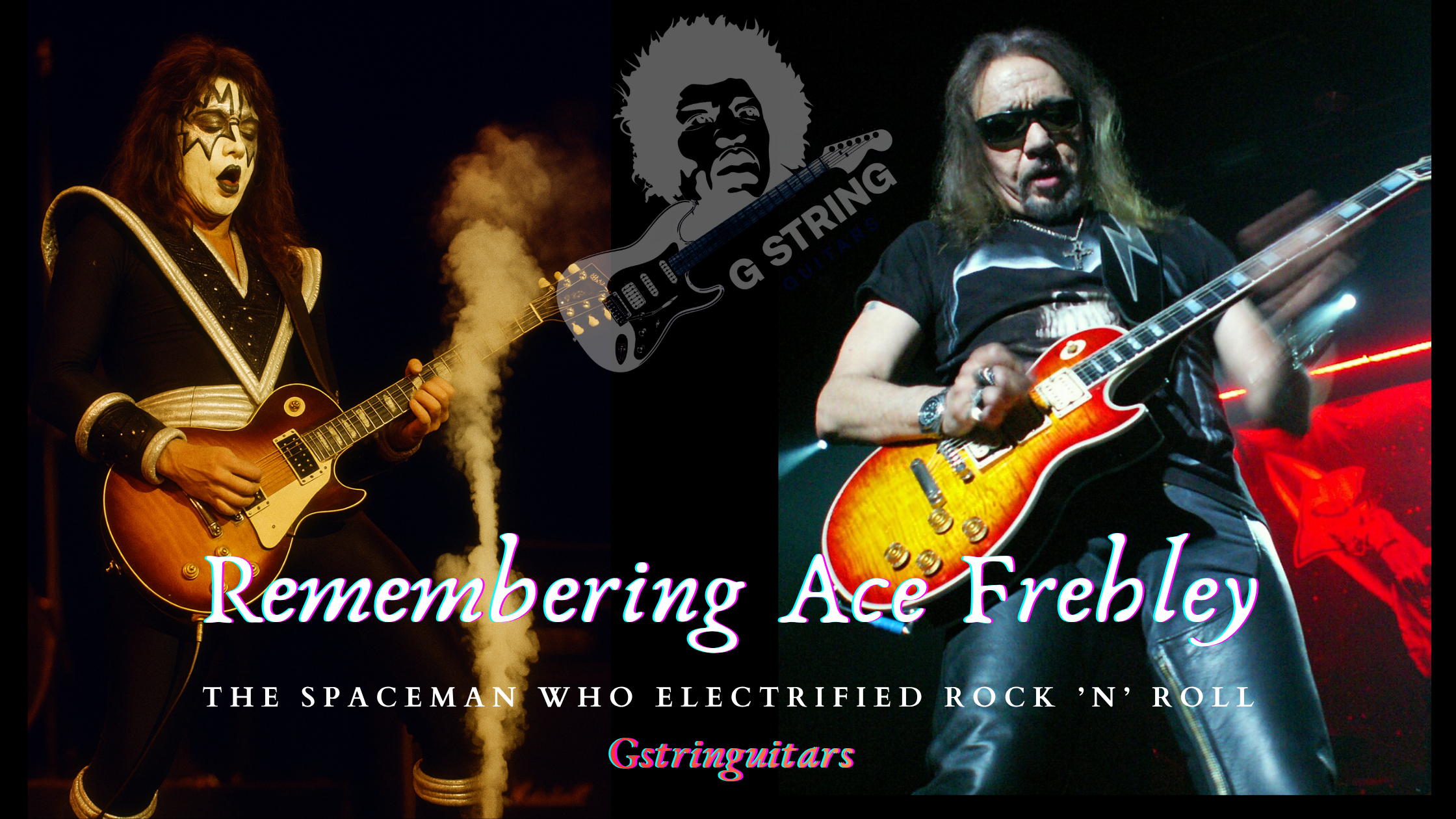
Remembering Ace Frehley: Pays Tribute to the Legendary KISS Guitarist Whose Explosive Solos, Signature Tone, and Larger-Than-Life Persona Changed Rock History.
Ace’s Fearless Approach to Guitar Playing Inspired Generations, Leaving Behind a Legacy that Continues to Electrify Fans and Musicians Around the World.
Read on…
Table of Contents
ToggleThis Post May Contain Affiliate Links
In compliance with the FTC guidelines, please assume that some of the links on these posts and sites are affiliate links (Amazon or others) from which I may earn a small compensation/commission from sales of certain items at no extra cost to you from qualifying purchases.
Anytime you see a link that looks like “astore.com, paid link, #ad, #CommissionsEarned or Amazon/Amazon.com/ca,”… it can be assumed that it is an affiliate link.
To learn more, follow the link below.
Remembering Ace Frehley: The Spaceman Who Electrified Rock’ n’ Roll
When you think of rock icons who shaped the sound and style of Electric Rock Guitar, few names shine brighter than Ace Frehley, a musician who wasn’t just a Guitarist but THE Rock Music world’s Spaceman!
A founding member of KISS, Ace brought that larger-than-life energy, melodic aggression, and swagger that helped define one of the biggest rock bands in history.
His solos, explosive tone, Signature Les Pauls, stage persona, presence, and fearless approach to Guitar playing didn’t just entertain; they inspired generations of musicians to pick up an Electric 6-string and push the boundaries of their own playing. (Including me)
In this post, Remembering Ace Frehley is more about G-stringuitars, looking to celebrate his life, his career, and the enduring influence of one of rock’s greatest Guitar Heroes, and the epic legacy he has left behind, as opposed to just looking at his Signature Guitars. (Which we will do in future posts)
Join me now.
🎸 TL;DR – Remembering Ace Frehley
Ace Frehley, co-founder and lead guitarist of KISS, shaped the sound and spectacle of 70s arena rock with his
melodic solos, signature Les Paul tone, and iconic “Spaceman” stage persona. From self-taught beginnings in
the Bronx to the platinum success of KISS and his solo work, Ace inspired generations of guitarists with
expressive playing and memorable showmanship, including the legendary smoking guitar stunt.
The takeaway: his legacy proves that personality, feel, and stage presence can leave as lasting an impact
on rock history as technical skill.
The Rise of the Spaceman
Ace Frehley’s Early Years
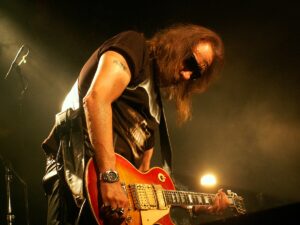
Ace Frehley in concert, June 2008. Image courtesy of Wikimedia – Author Tilly antoine -is licensed under the Creative Commons Attribution-Share Alike 4.0 International license.
Born Paul Daniel Frehley (April 27, 1951 – October 16, 2025) in The Bronx, New York, Ace grew up in a musical family, with both his parents playing piano.
After seeing bands like The Who and Cream live in New York, everything changed.
Watching Pete Townshend and Eric Clapton onstage flipped a switch in him, and from that moment on, the Guitar became his escape and his obsession.
No lessons, no school — just hours of self-taught playing along to Jimi Hendrix, Jeff Beck, Buddy Guy, B.B. King, and Led Zeppelin, the young Frehley was drawn to the Guitar’s power to evoke emotion and energy.
He often said that music “saved his life” by giving him purpose and pulling him away from the edge of street gangs or aimlessly bidding his days away.
Ace’s early bands were his training ground with groups like The Outrage, The Four Roses, King Kong, Honey, The Magic People, Cathedral and Molimo. (A project that went on to record a half-album demo for RCA Records in 1971.)
Somewhere in all that chaos, he earned the nickname ‘Ace’, thanks to his buddies, who said he was a sure bet when it came to getting dates.
The name stuck, and so did the swagger.
Joining Kiss
In late 1972, a friend showed him an ad in The Village Voice (a weekly alternative newspaper used for in-depth news, culture, and arts coverage) seeking a lead Guitarist.
It turned out to be for Paul Stanley, Gene Simmons, and Peter Criss.
The Audition
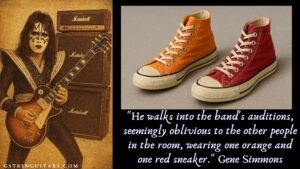
When he auditioned for the new budding group of musicians, Ace didn’t just bring talent; he brought attitude.
Gene recalls…
“He walks into the band’s auditions, seemingly oblivious to the other people in the room, wearing one orange and one red sneaker.”
Still, once Ace started playing, the audition quickly became a success; the sound he created was a perfect fit for what Gene and Paul were looking for.
Within weeks, he became KISS’s lead Guitarist, bringing his flair and showmanship to the band.
Naming & Design
The new group adopted the name KISS (January 1973), with Frehley designing the last two letters to resemble lightning bolts and refining them with Paul’s help.
KISS released their debut album in 1974, featuring Frehley’s songwriting on “Cold Gin” and “Love Theme from KISS.”
Ace Frehley KISS Era
Coming Up With Makeup
After seeing an Alice Cooper concert, the new group had an inspired idea.
The vision was to paint their faces for live performances, and they wanted to feature four versions of Alice Cooper on stage, each with their own unique makeup character, inspired by their individual personalities and interests.
His “Space Ace/Spaceman” persona (inspired by his love for sci-fi and space travel) was completed with silver and black makeup/costumes and custom-lifted boots, making him instantly recognizable. He used this character design from 1973 to 1982 and again from 1996 to 2002. (see image)
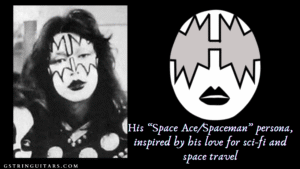
Image of Ace Makeup and Design from 1975 – Image courtesy of Wikimedia – Author Casablanca Records – and is in the public domain along with the Creative Commons Attribution-Share Alike 3.0 Unported license.
Anonymity
In the early years, they performed as mythological figures.
They maintained a sense of anonymity for over a decade, without the media or public ever seeing their faces without makeup.
The Famous “Smoker Guitar”
The Inspiration & Early Idea
Ace was keen to go beyond just playing Guitar — he wanted spectacle.
The cosmic stage persona was made for a theatrical extension of a Guitar with a literal smoking effect, reinforcing the band’s heavy rock theme. (See image)
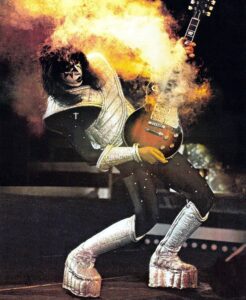
Kiss’s Alive II Tour with Smoker guitar – Image courtesy of Wikimedia – Author Casablanca Records – and is in the public domain
His first DIY “Smoking” stunt reportedly occurred during one of KISS’s early tours.
He placed a smoke bomb inside the cavity where the tone/volume controls typically sit on his Gibson Les Paul.
Lighting it by hand, the bomb allowed smoke to billow out through the pickups.
In his own words:
“I first came up with the idea to do the smoking guitar on our very first tour … I put smoke bombs inside the little compartment in a Les Paul … I used to light it with a cigarette lighter…” BLABBERMOUTH.NET
Invention Out Of Necessity
The initial DIY attempts achieved the desired effect but caused problems.
The wiring was damaged, the volume/tone pots failed, and the heat/ash all interfered with the control cavities.
To refine it, Ace and his band’s audio engineer, John Elder Robison, known as “Ampie“, built a safer design.
They created a metal box with asbestos insulation inside the Guitar’s back cavity, along with a dummy neck pickup.
(Ace never used the neck pickup, preferring only the bridge)
Ace Frehley’s Smoking Guitar Explained Video
The earlier ‘Smoker’—a 1977 Les Paul Custom—became the definitive take on the effect. Over time, it evolved into a tri-set up with the “white-hot pickup“, a design with an illuminated neck cavity, along with the signature smoke system.
Gibson even honoured him with a Signature Les Paul, still a collector’s dream.
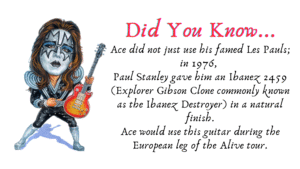
First Time Singing
His initial lack of confidence in his singing meant that other members often sang his songs.
Although he was initially hesitant, he eventually took lead vocals on “Shock Me” from 1977’s Love Gun.
He wrote the song himself after a real-life electrocution incident during a concert in Florida, caused by a short-circuited, ungrounded railing on a staircase.
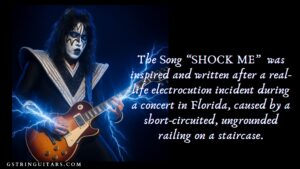
The Song marked his first time singing lead vocals on a KISS track, and he was so nervous that he recorded his vocals while lying on his back on the studio floor with Eddy Kramer.
The band’s encouragement to record it as his first lead vocal stemmed from his initiative in writing the song.
‘”I was really terrified to sing lead live, so Shock Me was the first song I was ever going to sing lead on, and the guys kind of pushed me in that direction, because they felt I was ready, and the first time I sang lead was on Shock Me at Madison Square Garden in front of 18,500 people.”
Ace Frehley
The Rise of Solo Work
In 1978, KISS released four individual albums simultaneously to fulfill their contract with the record label, granting the members creative freedom and attempting to prevent the band from breaking up due to internal tensions and exhaustion.
The solo albums allowed each member a chance to explore their own musical styles outside of the band’s collaborative efforts and decompress, all while ensuring the label received four solo albums, capitalizing on the band’s peak fame.
The simultaneous marketing of all four solo albums on the same release date was a feat never before achieved.
Least Likely to Succeed
Known for the band’s easygoing personality, he was even voted the member least likely to succeed with a solo project. The others joked that they’d lend a hand if he needed help recording.
Winning Process
He recounted the making of his 1978 debut solo album, noting that his songwriting process involves writing bass riffs before transferring them to the Guitar.
In the end, he needed the least support, and to add insult to injury, his solo work is often hailed as the best of the KISS solo releases, going platinum.
Tracks like “New York Groove” became a Top 20 hit in the U.S and remain staples of classic rock radio to this day.
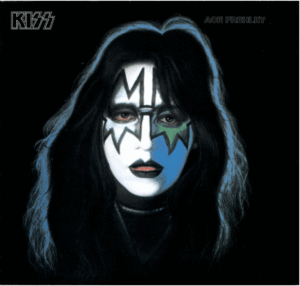
Ace Frehley’s 1978 debut solo album – Image courtesy of Amazon.com – Tap to see more.
Creative Differences
His songwriting presence within the group increased.
He contributed three songs for 1979’s Dynasty and three for 1980’s Unmasked.
But Ace wanted more input, which became more challenging, especially since Peter Criss was voted out of KISS in 1980.
He was often pushed aside in the 2–1 band song selection process, as replacement drummer Eric Carr, who was not a band partner, had no vote.
Frehley’s participation in the recording of 1981’s” Music for the Elder“ was far more limited than with previous albums.
This was mainly due to his dissatisfaction with the band’s decision to create a commercial-sounding concept album rather than a straightforward, rawer rock style project.
KISS’s nonstop touring, business demands, and growing focus on branding made him feel boxed in and less involved musically, leading to creative differences.
Leaving KISS
By 1982, the famed Guitarist decided he wanted to leave the group, declining to sign a $15 million contract, despite Stanley’s attempt to keep him in the band.
Frehley’s departure from KISS was a significant moment; it gave him the chance to regain control of his life/music and rediscover his own voice.
He appeared on the covers of the 1982 releases Killers and Creatures of the Night, even though he had no involvement with Killers and only minimal musical input on Creatures.
Frehley’s last appearances with the band were in the music video for “I Love It Loud“, a series of European promotional appearances in November 1982, and a band interview with MTV promoting their 10th anniversary world tour.
In December of the same year, KISS began the Creatures of the Night tour without Frehley, being replaced by new Guitarist Vinnie Vincent.
The band carried on without him, but his influence never faded.
Ace Frehley’s Solo Career
Frehleys Comet
Formed in 1984 with Anton Fig, John Regan, and Richie Scarlet, Frehley’s Comet built early momentum with demos and live shows before releasing their debut album on Megaforce Records in 1987.
Produced with Eddie Kramer, the album delivered standout tracks like “Into the Night” and “Rock Soldiers,” reminding fans of Ace’s unmistakable sound.
His solo work quickly proved he didn’t need makeup or theatrics; his songwriting, vocals, and signature Guitar style spoke for themselves.
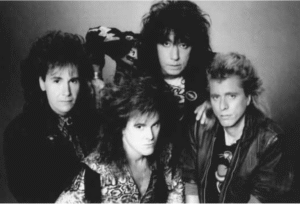
Publicity photo of American rock band Frehley’s Comet. L-R: John Regan, Tod Howarth, Ace Frehley, Jamie Oldaker – Image courtesy of Wikimedia – Author Megaforce/Atlantic Records – And is in the public domain
While later releases had mixed commercial success, Ace continued to experiment, take risks, and stay true to his musical vision, doing it all on his own terms.
Collaborations with Former KISS Members
Frehley reunited with Peter Criss on Trouble Walkin’ (1989), their first recording together since Dynasty, and a reminder of their enduring bond.
In 1995, they toured together on the “Bad Boys Tour,” a final run before being asked back for a KISS reunion.
Reunion Tour
Rejoining KISS in 1996 for their massive reunion tour, Ace rekindled the spark of nostalgia that made fans fall in love with the Spaceman decades earlier.
It was the first time that all four original members of the band performed live and toured since original drummer Peter Criss’ departure in 1980
After the tour, they announced that the original lineup would return to the studio to record a new album.
The resulting record, Psycho Circus, was promoted with a successful world tour; however, it later emerged that Frehley’s and Criss’ involvement was minimal.
“Into The Void” and “You Wanted The Best” were Frehley’s lone contributions to the record, with the former believed to be the only song that all four original members performed on.
After completing the “Farewell Tour” with KISS in late 2001, he again left the band and resumed his solo career. (See Image)
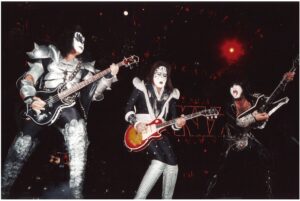
1999 “Psycho Circus World Tour.” – Image courtesy of Wikimedia – Author Jamiecat – and is under the Creative Commons Attribution 2.0 Generic license
In interviews, he has said that by the time of his 2002 exit, he felt he was “on a collision course” and staying would have been destructive.Louder+1
He emphasized sobriety, focused on his personal life and solo music, and again used this period to rebuild.
Restrictive Environment
As he had commented earlier, he felt more creative outside the band’s restrictive environment, with a sense of relief and the ability to redirect his energies.
Along with clearing up the confusion that, on both occasions (in 1982 and 2002), he had left by his own choice, not because he had been fired. Guitar+1
He continued to release albums, toured solo (though perhaps at a lower public profile than his KISS peak)
One-Off Performances
Ace occasionally reunited with former KISS bandmates for special events.
He appeared at the 2006 VH1 Rock Honours, performing “God of Thunder” with Rob Zombie, Slash, and others, and reunited with KISS again on the 2018 KISS KRUISE, his first time playing with them since 2002.
Though he joined these one-off performances, he never fully returned to KISS or participated in major tours after Psycho Circus, remaining firmly rooted in his solo work rather than a full-band comeback.
Ace Frehley Solo Albums — Chronological Breakdown
| Year | Title | Notes |
|---|---|---|
| 2009 | Anomaly | This was Ace’s comeback to original studio work after a long hiatus; self-produced and packed with that raw Spaceman energy. |
| 2014 | Space Invader | First new studio album since Anomaly. Landing in the U.S. Top 10 — one of his strongest chart performances. |
| 2016 | Origins Vol.1 | A tribute to the bands and songs that shaped Ace’s playing. A fan-favourite covers collection. |
| 2018 | Spaceman | This entirely original studio album showcases Ace still delivering riffs, swagger, and a classic tone. |
| 2020 | Origins Vol.2 | The follow-up to Origins Vol. 1, continuing his deep dive into the music that inspired him. |
Ace Frehley’s Final Years
His final album, 10,000 Volts (2024), was a reminder that Ace still had riffs, tone, and attitude that could hold their own against any generation of rockers, and he wasn’t done.
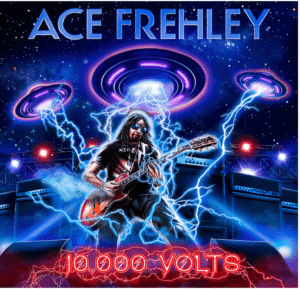
Ace’s Final Album. Image courtesy of Amazon.com – Tap to get yourself a copy
The album climbed to No. 72 on the Billboard 200 and topped the Hard Music and Rock Album charts.
It also secured strong international placements, proving that Ace’s spark did not dim; only evolve, and with Origins Vol. 3 planned for 2025, it’s clear that the Spaceman still had plenty of fuel left.
The Last Word On The Final KISS Tour
Ace claimed that the reunion talk was simply hype to sell tickets.
It was classic KISS drama, and he shared that he felt the band had become half parody of the original members and half cover band, with the newer members impersonating the originals.
He maintained that he tried to make the KISS “final show” happen, but it didn’t come together. BLABBERMOUTH.NET
Accolades
- In 1981, a star was named after Frehley in the International Star Registry.
- In 2014, the Rock and Roll Hall of Fame inducted the famed guitarist with his former bandmates.
- Guitar World even ranked him among the greatest metal Guitarists of all time.
Ace In Print
Ace Frehley released his autobiography, No Regrets – A Rock ‘N’ Roll Memoir, on November 1, 2011.
The project was authored by Joe Layden, John Ostrosky, and Joe Frehley, and published by Gallery Books, a Simon & Schuster imprint.
The book entered The New York Times Best Seller list in the hardcover non-fiction category at No. 10.
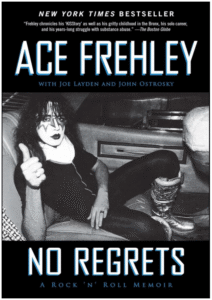
A New York Times bestselling memoir – Image courtesy of Amazon.com – Tap to see more.
Players Inspired by the Spaceman
Ace Frehley has said in the book KISS: Behind the Mask that countless Guitarists picked up the instrument after hearing him on the band’s “Alive Album.”
He was constantly surprised by the scale of his influence, acknowledging that, while he is not a traditional technically flawless player, and that how he plays “cannot be taught“, he stated…
“If I knew I was going to influence so many Guitarists, I would have practiced more.“
In a 2009 Rock N Roll Experience interview, he laughed, calling himself…
“An anomaly — an unschooled musician who can’t read music, yet somehow became one of the most famous Guitar players in the world.”
Following with advice and inspiration to all future players…
“My advice for anybody in life is just do what you enjoy doing, and don’t give up, persevere, and practice, practice and practice.”
Some of these next-gen Guitarists he inspired went on to become rock gods themselves, including Slash, Dimebag Darrell, and Jason Hook.
Hook’s Admiration Runs Deep
For the former Five Finger Death Punch Guitarist, Ace wasn’t just a musical idol.
Hook has long praised Frehley for his melodic riffs and memorable songwriting, noting in a 2014 Seymour Duncan interview that Ace’s impact came from feel rather than flash.
He has showcased KISS Guitars from his collection, discussed auditioning for Frehley’s band, and frequently credited Ace as a significant influence on his career.
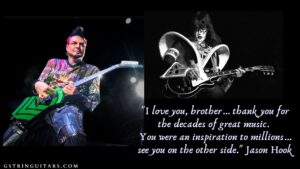
When Frehley passed away, Hook posted a heartfelt tribute, calling him his hero and thanking him for decades of inspiration, saying…
“I love you, brother… thank you for the decades of great music. You were an inspiration to millions… see you on the other side.”
He’s also shared footage of the two jamming together at the Gibson Showroom — a highlight for any lifelong fan.
Did You Know
Hook created and placed a unique Ace-inspired tattoo, cementing Frehley’s influence on his musical journey and personal style.
Hallmarks of Ace’s Style
Ace Frehley’s Signature Sound
The famed Guitarist had a gift for crafting melodic solos, as well as playing to the song, not over it.
Instead of shredding for speed, his leads often echoed the vocal lines or answered the main riff.
Every note had intention, feel, and attitude, connecting with listeners.
Tracks like Love Gun and Detroit Rock City showed how much he could say in just a few bars and lock in perfectly into that signature KISS groove.
Individual Playing Technique
Ace was freshly honest about his approach to his Guitar playing and technique.
In a Guitar World interview years earlier, he admitted…
“I play guitar in such an unorthodox way. I’ve never taken a lesson, and sometimes my thumb even ends up on the fretted side of the neck. I don’t know why, but it works.”
Paul Stanley once reminisced about those early days, saying…
“I’d use my hand for vibrato – Ace would shake his whole arm against the neck.”
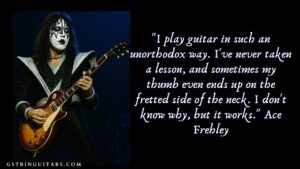
Pentatonic Playing & Amp Dynamics
Frehley’s solo vocabulary primarily came from the minor pentatonic scale, but he made it sound expansive by blending phrasing, sustain and tone control.
He also had a natural sense for Amp interaction. He’d ride his Guitar’s volume knob to clean up the tone mid-song, then crank it back for solos, giving his Les Paul and Marshall combo incredible versatility and dynamic control live.
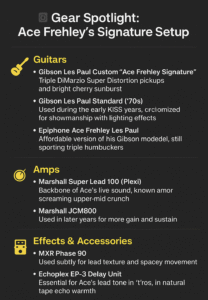
Ace Frehley’s Gear Spotlight
The Loss Of A Guitar Icon
Ace passed away on October 16, 2025, following complications from a fall in his home studio. He was placed on life support after suffering a brain bleed, but ultimately did not recover.
He was 74 and is survived by his daughter, wife, brother, and sister.
His Former KISS Bandmates Pay Tribute
Gene Simmons wrote on social media:
“Our hearts are broken … Sadder still, Ace didn’t live long enough to be honored at the Kennedy Center. Ace was the eternal rock soldier. Long may his legacy live on.”
Paul Stanley added a personal memory, recalling hearing Ace playing in 1974:
“He played like lightning, laughed like thunder, and lived louder than anyone I’ve ever known.”
Peter Criss issued a deeply personal message:
“With a broken heart and deep, deep sadness, my brother Ace Frehley has passed away. He died peacefully with his family around him. My wife and I were with him to the end as well. I love you, my brother.”
He added:
“Ace influenced and touched the hearts of millions of people. His legacy will live on … in the hearts of the KISS Army.”
FAQ
Gene Simmons and Paul Stanley own the trademark. Tommy Thayer later performed as the Spaceman using the same design.
It was rocky at times, but rooted in a shared history and eventually led to respect.
There is no recent, reliable update on his IQ following his death. The commonly cited number is 163, but that comes from past interviews and has not been independently verified by major news outlets in connection with his obituary.
Ace passed away in October 2025 at 74 after a fall that caused a brain bleed.
Ace left in the early ’80s due to creative clashes and substance abuse issues. He rejoined for the 1996 reunion but left again in 2002 after business disagreements.
Final Thoughts
Ace Frehley’s Legacy
He was my first Guitar Hero—the one who made me believe in the dream of living a life as a professional musician.
The image, the energy, the sense of possibility… it all felt limitless to a 7-year-old kid picking up the instrument for the first time.
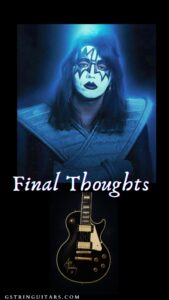
To this day, many decades later, after following and being inspired by many players after him, writing this post has reconnected me to why he was so influential.
His mix of attitude, melody, and individuality still shapes every Guitarist who chases their own sound.
Ace Frehley leaves behind more than riffs and records; he leaves a blueprint for everyone who plays with heart first.
As we move forward, we carry that energy with us: the courage to be ourselves, the guts to take risks, and the joy of creating something that feels alive.
The TRUE Spaceman may be gone, but the fire he lit in players around the world will never fade, and my adoration for my first true Guitar Hero will always remain… Eternal.
Did You Like This Post?
Check out my post on The Signature Gibson Jason Hook Guitar
Also…
Leave your comments below if you want me to review a favourite Guitar, player or topic.
Stay the course, keep playing, and see you in a few weeks.
I’m Dino Paniccia — a Guitarist, Gear enthusiast, and the founder of GStringuitars.com. I’ve spent years playing, teaching, recording, researching, and writing about Electric Guitars, with a particular focus on Signature Models and what actually makes them special for real players. My goal is to break down tone, feel, and design in a practical, player-first way so Guitarists can make confident, informed gear decisions.
Summarize This Content With AI
Attributions
Blog Post feature image of Ace Frehley 2008 (Cropped) without makeup is courtesy of Wikimedia – Author – Tilly antoine – and is licensed under the Creative Commons Attribution-Share Alike 4.0 International license
Cartoon adaptation of Ace Frehley’s image is courtesy of Amazon.com
Gstringuitars have created images without attribution via ChatGPT.com
Image of Jason Hook playing live in November 2015 is courtesy of Wikimedia – Author PaliH – is licensed under the Creative Commons Attribution-Share Alike 4.0 International
Final thoughts, image of Ace Frehley is courtesy of Amazon.com
To get back to the home page – Tap the logo image
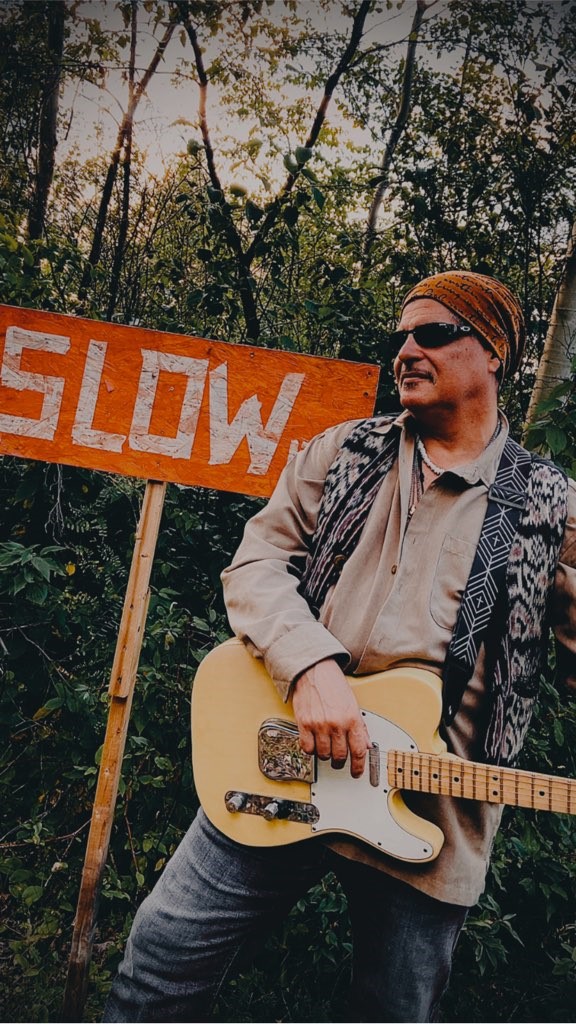
Starting A Journey At 7 Years Of Age, The Love For The Guitar Only Became Stronger Going Into My Teens. This Leading To An Exciting Time Of Teaching, Performing, And Recording. Join Me Now As We Can Bring The Love Of This Instrument To Other Musicians Globally.